
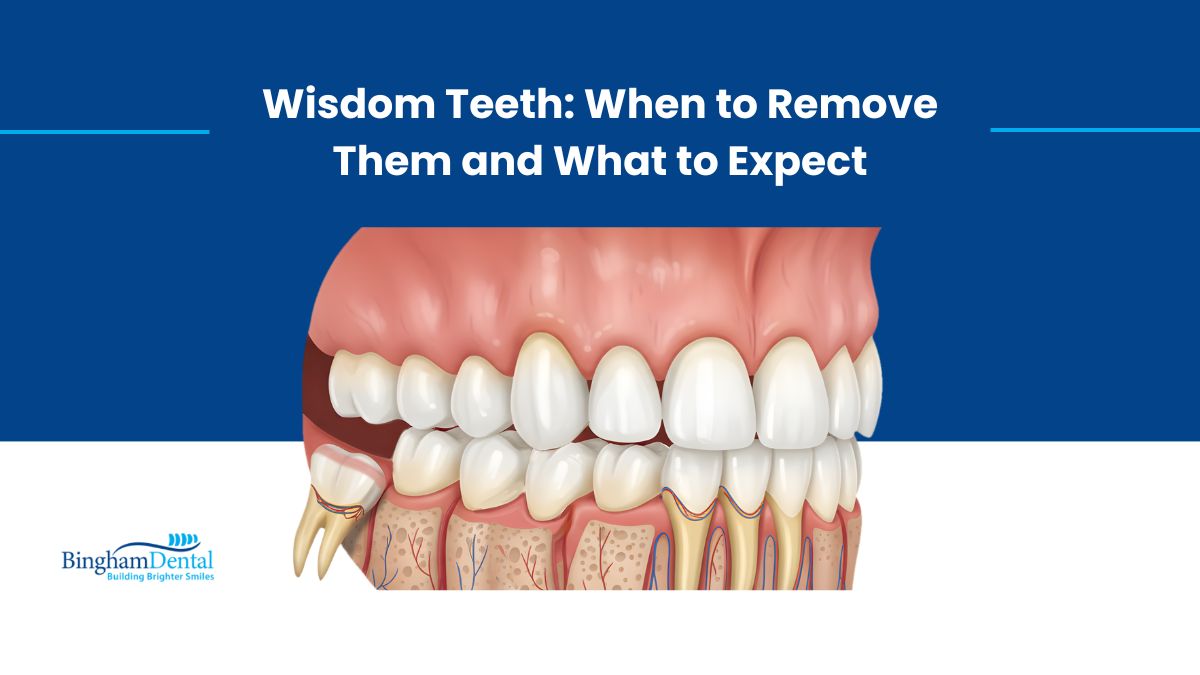
Wisdom teeth — the third set of molars at the very back of the mouth — are a rite of passage for most young adults. For some people, they come in without any issues and require no intervention. For many others, however, wisdom teeth cause problems that make extraction the most practical choice. At Bingham Dental, we evaluate wisdom teeth as part of routine care and guide patients through the removal process when it’s needed.
What Are Wisdom Teeth and When Do They Emerge?
Wisdom teeth are the last permanent teeth to develop, typically emerging between the ages of 17 and 25 — a period sometimes associated with the development of wisdom, hence the name. Most adults develop four wisdom teeth, one in each corner of the mouth, though it’s not uncommon for some people to have fewer, or in rare cases, none at all.
Why Do Wisdom Teeth Cause Problems?
Modern human jaws are often not large enough to comfortably accommodate four additional molars. When wisdom teeth don’t have adequate space to emerge fully and properly, they may become impacted — meaning they remain partially or fully beneath the gumline, or emerge at an angle that puts them in direct contact with the adjacent tooth.
Impacted wisdom teeth can lead to pain and pressure at the back of the jaw, increased risk of infection in the surrounding gum tissue (a condition called pericoronitis), damage to the roots of the neighboring second molar, development of cysts around the impacted tooth, and crowding of other teeth in some cases.
Even wisdom teeth that appear to have emerged without obvious problems can be difficult to clean effectively because of their location at the very back of the mouth, making them more prone to cavities and gum disease than other teeth.
Monitoring Wisdom Teeth With X-Rays
Because wisdom teeth develop below the surface long before they emerge, dental X-rays are the most reliable way to monitor their position and angle of development. At Bingham Dental, we track wisdom tooth development as part of routine care, allowing us to anticipate potential problems and discuss extraction timing before a situation becomes urgent.
What to Expect During Wisdom Tooth Removal
Wisdom tooth removal is one of the most commonly performed dental procedures. Depending on the position and level of impaction, the procedure may be a simple extraction or may require a surgical approach with a small incision and, in some cases, sectioning the tooth for easier removal. Local anesthesia is used for all extractions, with additional sedation options available for patients who need extra comfort.
Recovery typically involves a few days of swelling, soreness, and dietary modification — soft foods are recommended while the sockets heal. Following post-operative instructions carefully, particularly avoiding straws and smoking in the first few days, significantly supports healing and reduces the risk of complications.
Conclusion
Wisdom teeth don’t always need to come out, but when they do, timing and preparation make a real difference. Regular monitoring with X-rays, a proactive conversation with your dentist, and a clear understanding of the procedure and recovery all contribute to the smoothest possible experience.
Frequently Asked Questions
Does everyone need their wisdom teeth removed?
No — wisdom teeth that come in fully, are positioned correctly, and can be kept clean and cavity-free don’t necessarily need to be removed. Extraction is recommended when they’re impacted, infected, or threatening neighboring teeth.
What is the best age to have wisdom teeth removed?
Earlier is generally better when removal is needed, since the roots are less fully developed in the late teens and early twenties, making extraction more straightforward and recovery typically faster.
How long does recovery take after wisdom tooth removal?
Most patients feel significantly better within three to five days, with full healing taking several weeks. Following post-operative instructions carefully supports the fastest recovery.
Will I be awake during wisdom tooth removal?
Most wisdom tooth extractions are performed with local anesthesia, keeping you awake but pain-free. Sedation options are available for patients who would prefer additional relaxation during the procedure.
What’s the risk of not removing impacted wisdom teeth?
Impacted wisdom teeth left in place can lead to ongoing infection, damage to adjacent teeth, cyst formation, and chronic pain — which is why monitoring and timely removal when needed is important.
Wisdom Tooth Evaluations and Removal at Bingham Dental
Our team monitors wisdom tooth development as part of routine care and performs extractions in a comfortable, familiar environment when the time is right.
Call (801) 250-7422 or book an appointment online with our Magna, UT team to discuss your wisdom teeth.