
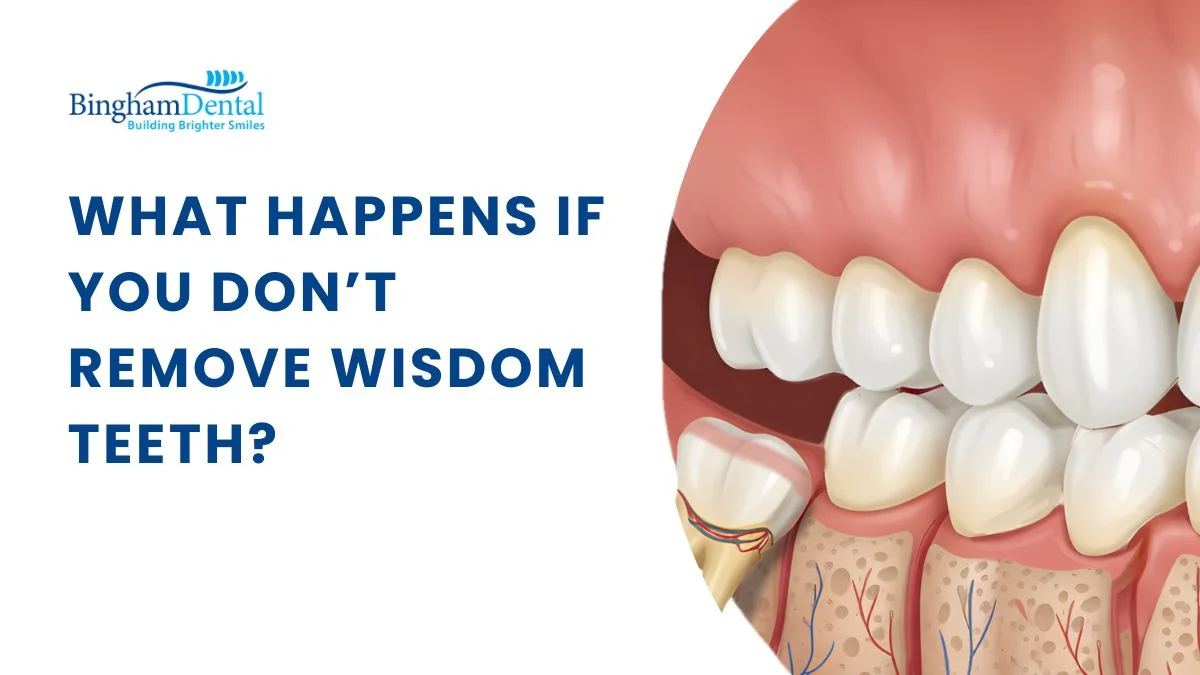
Not every wisdom tooth causes trouble, so it’s a fair question: what happens if you don’t remove wisdom teeth that your dentist has flagged on an X-ray? The honest answer depends entirely on how they’re positioned — some sit fine for life, while others quietly cause damage long before you feel any pain.
Here’s what actually happens if you don’t remove wisdom teeth in each of the common scenarios, and how to tell which situation you’re in.
Why Wisdom Teeth Cause Problems in the First Place
Most adult jaws simply don’t have room for a third set of molars. When there isn’t enough space, wisdom teeth come in sideways, only partway, or press against the teeth next to them — a situation dentists call impaction. It’s this crowding, not the teeth themselves, that creates most of the downstream risk.
Human jaws have gradually gotten smaller over generations, partly as a result of softer, more processed diets that require less chewing force than the diets of our ancestors. Wisdom teeth, meanwhile, haven’t disappeared from our genetic blueprint at the same pace, which is why so many people end up with a mismatch between the number of teeth trying to erupt and the amount of room actually available.
📸 Image Suggestion: A dentist pointing to a wisdom tooth area on a dental X-ray with a patient.
Image Prompt: Photorealistic photograph of a dentist showing a patient a dental X-ray on a screen, pointing to the back molar area, bright clinical office.
The Real Risks of Leaving Problem Wisdom Teeth In
This is really the heart of what happens if you don’t remove wisdom teeth that are impacted or partially erupted — the complications tend to build quietly over months or years:
Hidden infection: a partially erupted tooth leaves a flap of gum tissue that traps bacteria, which can lead to a painful infection called pericoronitis.
Decay in the tooth next door: wisdom teeth that grow at an angle push against neighboring molars, creating a tight gap where plaque builds up and cavities form on both teeth.
Cysts: a fluid-filled sac can form around an impacted tooth over time, and left untreated it can damage the jawbone or nearby nerves.
Crowding of other teeth: pressure from an erupting wisdom tooth can gradually shift your other teeth out of alignment.
Gum disease: the back of the mouth is already hard to clean, and a partially erupted wisdom tooth makes it nearly impossible in that spot.
When It’s Actually Fine to Keep Them
Not every case requires extraction. If a wisdom tooth has fully erupted, sits in proper alignment with its opposing tooth, and you can clean around it as easily as any other molar, there’s often no urgent reason to remove it. In these cases, dentists typically recommend monitoring rather than automatic surgery.
Signs It’s Time to Stop Waiting
Certain symptoms are a clear signal that watchful waiting has run its course: persistent pain or swelling near the back of the jaw, a bad taste or odor that won’t go away, difficulty opening your mouth fully, or a cyst spotted on a routine X-ray. Any of these warrant a conversation about extraction sooner rather than later.
It’s worth noting that some of the most damaging cases develop with very little discomfort until they’re fairly advanced, which is exactly why routine dental X-rays matter even when nothing feels wrong. A dentist can often spot early warning signs, like the beginning of a cyst or subtle bone loss around a wisdom tooth, well before you’d ever notice them yourself.
What Monitoring Looks Like Instead
If your dentist decides your wisdom teeth can stay for now, that doesn’t mean ignoring them. Monitoring usually means periodic X-rays to track their position, a close look at the surrounding gum tissue at each cleaning, and prompt attention the moment symptoms appear — which keeps a manageable situation from turning into an emergency.
How the Removal Process Generally Works
If your dentist does recommend extraction, the process usually starts with a referral to an oral surgeon, who reviews your X-rays and discusses anesthesia options ranging from local numbing to sedation, depending on how the teeth are positioned. Simple extractions of fully erupted teeth tend to be quick, while impacted teeth that are angled or buried in bone take a bit longer and involve a slightly more involved recovery.
Most patients are back to normal activities within a few days, with some swelling and tenderness that responds well to ice and over-the-counter pain relief. Following the aftercare instructions closely — soft foods, no straws, and gentle rinsing — makes a noticeable difference in how smoothly healing goes.
Cost Considerations: Removal vs. Waiting
Planned extractions are almost always less expensive and less complicated than emergency treatment for an infected or impacted tooth down the road. Waiting isn’t free, either — it just shifts the cost to a less predictable point in time, often alongside urgent care fees or the price of treating a cyst or damaged neighboring tooth.
This is part of why dentists weigh what happens if you don’t remove wisdom teeth against the relatively modest cost of a planned procedure. Most dental insurance plans also cover a meaningful portion of extraction costs when the removal is medically indicated, which is worth confirming with your insurer before deciding either way.
How Age Affects the Decision
Younger patients, generally in their late teens or early twenties, tend to recover faster and more predictably from wisdom tooth extraction. The roots aren’t fully formed yet and the surrounding bone is less dense, which makes the procedure more straightforward and the healing period shorter than it typically is for someone in their thirties or forties facing the same decision.
That doesn’t mean older adults can’t safely have wisdom teeth removed — plenty do, with good outcomes. It just means the conversation about what happens if you don’t remove wisdom teeth versus waiting even longer tends to carry a bit more weight as you get older, since recovery slows and complications become somewhat more likely with age.
Talking to Family Members About Their History
Since impaction risk runs partly in families, it’s worth asking parents or siblings whether they’ve had wisdom teeth removed, and if so, why. A shared family pattern of impaction or crowding doesn’t guarantee the same outcome for you, but it’s a useful piece of context to mention at your own exam.
Questions Worth Asking at Your Next Exam
Are my wisdom teeth impacted or fully erupted?: this single question sets the tone for whether monitoring or removal is even on the table.
Is there any sign of decay, infection, or a cyst?: these findings usually push the conversation toward removal sooner rather than later.
How much room do I actually have?: crowded jaws are more likely to run into problems as wisdom teeth try to erupt.
What would monitoring look like for me specifically?: ask how often you should get X-rays if you’re choosing to wait.
Frequently Asked Questions
Q: Is it okay to never remove wisdom teeth?
It’s okay to never remove wisdom teeth as long as they’re fully erupted, properly aligned, and easy to keep clean, with no signs of decay, infection, or crowding.
Many adults keep healthy, functional wisdom teeth for life. The key is ongoing monitoring, since a tooth that looks fine at 20 can still shift or develop problems later.
Q: How long can a wisdom tooth go untreated?
There’s no fixed timeline — a wisdom tooth causing no symptoms can go years without treatment, while an actively infected or painful one should be addressed within days to avoid the infection spreading.
The safest approach is letting your dentist assess the specific tooth rather than guessing based on how it feels, since some of the most damaging cases cause very little pain until they’re advanced.
Q: Can you live your life without removing your wisdom teeth?
Yes — plenty of people go their entire lives without ever having their wisdom teeth removed, particularly when the teeth are well-positioned and cause no ongoing issues.
The tradeoff is committing to regular dental checkups, since a wisdom tooth that’s fine today can still develop problems as your mouth changes with age.
Q: How long can you go without removing your wisdom teeth?
For a healthy, well-aligned wisdom tooth, there’s no expiration date on waiting — but for an impacted or symptomatic one, delaying removal for years raises the odds of infection, cysts, or damage to nearby teeth.
This is exactly why what happens if you don’t remove wisdom teeth matters so much as a question to ask your own dentist, rather than relying on a general rule that applies to every mouth equally.
Conclusions
Whether removal makes sense really comes down to your specific X-rays and symptoms, not a blanket rule. Plenty of wisdom teeth cause no trouble at all, while others quietly build toward a bigger problem. Getting an honest answer starts with a current set of images and an exam, not guesswork.
The team at Bingham Dental in Magna can take a look at your wisdom teeth and tell you plainly whether monitoring or extraction is the right call for you.