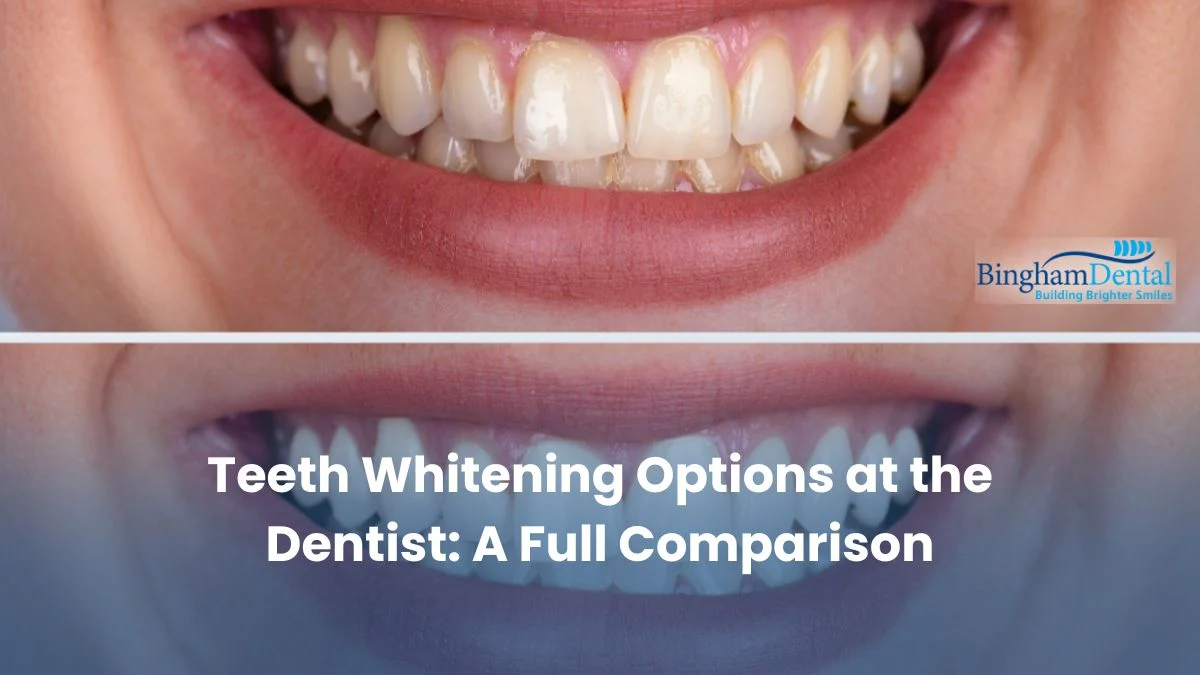
Drugstore shelves are full of whitening products, but the teeth whitening options at the dentist tend to work faster, more predictably, and more safely than anything sold over the counter. The question is usually which specific option fits your timeline and budget.
Here’s how the main choices actually compare.
In-Office Professional Whitening
This is the fastest of all the teeth whitening options at the dentist, typically completed in about 90 minutes in a single visit. A high-concentration bleaching gel is applied directly to the teeth after the gums are protected with a barrier, often producing a noticeably brighter smile before you leave the office.
Some in-office systems also use a special light to help activate the whitening gel and speed the process along. Because everything happens under direct professional supervision, your dentist can monitor sensitivity in real time and adjust the treatment if needed, something that isn’t possible with any at-home product.
Custom Take-Home Trays
Your dentist creates a mold of your teeth to make custom-fitted trays, which you fill with a lower-concentration gel and wear for a set period each day, usually over one to two weeks. This option costs less than in-office treatment and still outperforms generic drugstore kits, since the trays fit your teeth precisely and limit gel contact with your gums.
Paint-On and Strip Options
Some dentists offer or recommend specific paint-on whiteners or professional-grade strips for milder cases or touch-ups between bigger treatments. These tend to be the most affordable of the teeth whitening options at the dentist, though results are generally more modest and slower to appear than trays or in-office bleaching.
How Dentists Decide Which Option Fits You
Timeline: in-office whitening suits anyone who wants results before a specific event, while trays work well for a more gradual approach.
- Sensitivity history: patients prone to sensitivity may do better with a lower-concentration take-home option.
- Budget: in-office treatment costs more upfront but requires less of your own time and effort.
- Type of staining: stubborn or intrinsic stains often respond better to stronger, dentist-supervised treatments than milder over-the-counter options.
Safety Compared to DIY Kits
Dentist-supervised whitening carries less risk than generic drugstore kits, mainly because the gum protection and gel concentration are professionally controlled. Over-the-counter kits can cause uneven results or gum irritation if the tray or strip doesn’t fit properly, which a dental office simply avoids by customizing everything to your mouth.
What a Consultation Usually Involves
Before recommending any whitening treatment, your provider will typically check for cavities, gum disease, or existing dental work that could affect the outcome, since whitening isn’t recommended until any active decay is treated first. They’ll also ask about your goals and timeline, which helps narrow down which method makes the most sense.
This short evaluation is also the best time to ask about cost, expected sensitivity, and how long results typically last for someone with your specific type of staining, so you know what to expect before committing to a plan.
Managing Sensitivity During Treatment
Sensitivity is the most common side effect across every whitening method, and it’s usually temporary. Dentists can adjust gel concentration, treatment time, or recommend a desensitizing toothpaste before and after treatment to keep discomfort manageable, something that’s much harder to fine-tune with a one-size-fits-all drugstore kit.
If sensitivity does show up, it typically fades within a day or two of finishing treatment. Letting your dentist know how you’re responding partway through a multi-day plan also gives them the chance to adjust the approach before it becomes uncomfortable.
Combining Whitening With Other Treatments
Many patients whiten before getting bonding, veneers, or a new crown placed on a visible tooth, since it lets the dentist match the new restoration to a brighter, more current shade rather than your starting color. Doing things in this order avoids a mismatch that can be difficult or costly to correct later.
How Long Each Option Actually Takes
In-office whitening is done in a single roughly 90-minute appointment. Take-home trays typically require one to two weeks of nightly wear before reaching their full effect. Paint-on and strip options fall somewhere in between, often needing a couple of weeks of daily use to see a noticeable difference, depending on the product’s strength.
Time commitment is a genuinely practical factor for a lot of patients — someone preparing for an event next week has very different needs than someone whitening on a flexible, no-deadline timeline.
Cost Ranges to Expect
In-office whitening is generally the most expensive single option, custom take-home trays sit in the middle, and dentist-recommended strips or paint-on products are usually the least expensive of the three. Prices vary by practice and by how much correction your teeth need, so an exact number really only comes from a consultation rather than a general estimate.
Preparing for Any Whitening Appointment
A cleaning shortly beforehand helps whitening gel reach the tooth surface more evenly, since it removes surface plaque and buildup first. It’s also worth mentioning any sensitivity history, existing dental work on visible teeth, or upcoming events with a specific deadline, since all three can shape which option your dentist ultimately recommends.
Questions Worth Asking Before You Choose
- Which option fits my timeline best?: be upfront about any deadline you’re working toward.
- What results are realistic for my staining type?: set expectations before you commit to a plan.
- How should I care for existing dental work during treatment?: crowns and fillings won’t change color, so this matters for a consistent look.
Why Professional Supervision Matters Most for Sensitive Teeth
Patients with a history of sensitivity sometimes assume whitening is off the table entirely, but that’s rarely the case with professional guidance. A dentist can start with a lower concentration, space out sessions differently, or recommend a desensitizing step beforehand — adjustments that simply aren’t possible with a generic over-the-counter product.
The Bottom Line
Every professionally supervised option beats a generic drugstore kit on safety, consistency, and results — the real decision is simply how fast you want to see a change and what you’re comfortable spending. A short consultation clears up both in a matter of minutes.
Maintaining Results After Any Method
Whichever option you choose, the same maintenance habits keep results looking their best for longer: limiting coffee, tea, red wine, and tobacco, rinsing or brushing soon after consuming staining foods and drinks, and scheduling a touch-up before results have faded all the way back to your starting shade.
Frequently Asked Questions
Q: Is it worth getting your teeth whitened at the dentist?
For most people, yes — teeth whitening options at the dentist deliver faster, more even, and longer-lasting results than store-bought alternatives, with far less risk of gum irritation.
The extra cost compared to a drugstore kit typically buys you a custom fit, professional-strength gel, and a dentist’s oversight if any sensitivity comes up.
Q: What is the most effective teeth whitening from a dentist?
In-office professional whitening is generally the most effective single-visit option, using a higher-concentration bleaching gel that produces faster, more dramatic results than take-home alternatives.
Custom take-home trays can achieve similarly strong results over a longer period, so ‘most effective’ sometimes comes down to how quickly you want to see a change.
Q: Can yellow teeth actually be whitened?
Yes — yellow-toned teeth typically respond very well to whitening treatments, often more predictably than teeth with a gray undertone.
This is one of the more encouraging aspects of stain-based discoloration: most yellow staining is extrinsic, meaning it sits on the surface and responds well to standard bleaching methods.
Q: What is better, Zoom whitening or trays?
Zoom and similar in-office treatments give faster results in a single visit, while custom trays achieve comparable brightness over a week or two with more flexibility around your schedule.
Neither is universally ‘better’ — it depends on whether you value speed or convenience, and your dentist can help match the choice to your specific situation.
Conclusions
Weighing the teeth whitening options at the dentist really comes down to how fast you want results and how much you’re comfortable spending upfront. In-office treatment wins on speed, while trays offer a gentler, more gradual path to the same brightness. Either way, professional supervision reduces the risks that come with generic drugstore kits.
To find the option that fits your smile and schedule, Bingham Dental in Magna can walk you through a consultation.