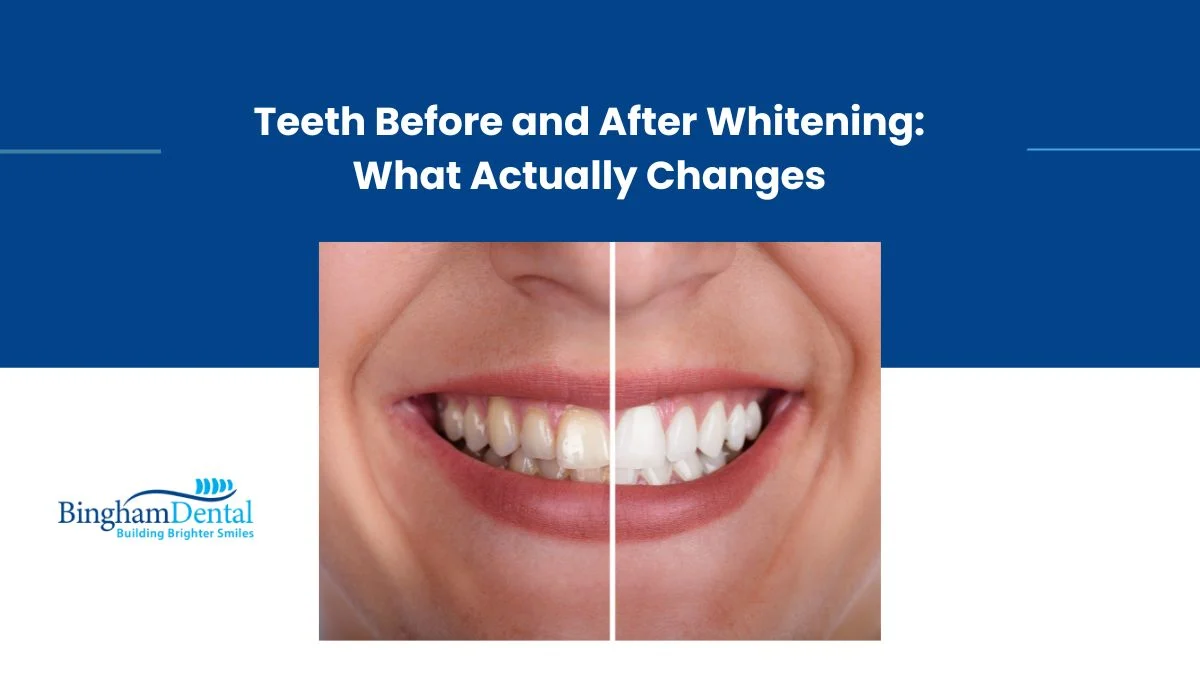
Photos of teeth before and after whitening can look almost too good to be true, and it’s natural to wonder how much of that is realistic for your own smile. The honest answer is that results vary quite a bit from person to person, based on factors most people never think to ask about.
Here’s what’s actually happening beneath the surface, and what determines how dramatic your own before-and-after will be.
What Happens to Your Teeth During Whitening
Whitening agents — usually hydrogen or carbamide peroxide — penetrate the enamel and break apart the pigmented molecules responsible for staining. This is a chemical change, not a cleaning process, which is why whitening can lighten teeth that are already free of visible plaque or surface stain.
The peroxide molecules work their way through microscopic pores in the enamel and into the layer just beneath it, called dentin, where a lot of the deeper discoloration actually lives. That’s part of why professional treatments, with their higher-concentration gels and longer or more controlled contact time, tend to reach discoloration that surface-level products like whitening toothpaste can’t fully address.
Why Everyone Responds a Little Differently
No two smiles start from the same baseline, which is exactly why one person’s dramatic before-and-after doesn’t guarantee the same outcome for someone else. Enamel thickness, natural tooth color, age, and the specific cause of staining all play a role in how much visible change any given treatment produces.
A dentist examining your teeth before recommending a whitening plan is looking at exactly these variables, which is why an in-person evaluation tends to set more realistic expectations than judging your likely results from someone else’s online photos.
What Changes Between Before and After
Most people see their teeth become two to eight shades brighter, with results visible almost immediately after an in-office session. The exact number depends heavily on your starting shade and the type of staining involved — yellow-toned teeth tend to whiten more dramatically and predictably than gray-toned teeth.
Factors That Affect Your Own Results
Type of staining: extrinsic stains from coffee, tea, or smoking respond best to bleaching, while intrinsic stains from aging or certain medications are more stubborn.
Starting shade: teeth that start out yellow-toned typically whiten faster and more noticeably than teeth with a gray undertone.
Method used: in-office treatments produce a more dramatic before-and-after in a single visit compared to gradual at-home options.
What to Expect Right After Treatment
Mild tooth sensitivity for 24 to 48 hours is common right after whitening, and it typically fades on its own. During that same window, your teeth are more porous and prone to picking up new stains, so most dentists recommend avoiding coffee, tea, red wine, and other dark foods and drinks for about 48 hours.
Keeping Your After Results Looking Like Day One
Whitened teeth don’t stay that way forever without some upkeep. Brushing with a whitening toothpaste, drinking dark beverages through a straw, and keeping up with regular cleanings all help extend how long your results last before a touch-up is needed.
Comparing In-Office and At-Home Before-and-After Results
In-office whitening tends to produce the most dramatic single-visit transformation, since a stronger bleaching gel is applied under professional supervision. At-home tray systems reach a similar final shade, but the change unfolds gradually over one to two weeks rather than in a single afternoon, which some patients actually prefer since it feels more natural to friends and coworkers.
Photos of teeth before and after whitening from each method can look surprisingly similar once the full course is complete, even though the timeline getting there is very different. The deciding factor usually comes down to patience versus convenience, not effectiveness.
What a Realistic Before-and-After Photo Should Show
Be cautious of marketing photos of teeth before and after whitening that look implausibly white — genuine results usually land in a natural, brighter shade of your own enamel rather than an artificial, uniform white. Lighting, filters, and camera settings can also exaggerate the difference in promotional images, so it’s worth asking your dentist to show you real, unedited patient examples during a consultation.
When Whitening Alone Won’t Get You There
Not every kind of discoloration responds to bleaching. Stains from certain medications taken during childhood, old trauma to a tooth, or a naturally gray undertone can all limit how dramatic your before-and-after actually looks, no matter how strong the whitening treatment is. In these cases, a dentist may suggest bonding or veneers as a more realistic way to reach the brightness you’re picturing.
A quick shade evaluation before you start is the easiest way to set expectations honestly, rather than being disappointed by a before-and-after that doesn’t match what you saw in an online ad.
Touch-Ups: Keeping the After Looking Fresh
Even with good habits, most people eventually want a touch-up to maintain their results. A quick in-office session or a few nights back in your custom trays is usually all it takes to restore your brightness, since you’re maintaining an existing result rather than starting from your original shade.
Is Whitening Safe for Everyone?
Whitening is generally safe for adults with healthy teeth and gums, but it isn’t recommended for children under a certain age, pregnant or nursing patients as a precaution, or anyone with untreated cavities or significant gum disease. A quick exam before treatment catches most of these situations before they become a problem.
People with very sensitive teeth aren’t necessarily ruled out either — a dentist can often adjust the gel strength or contact time to make treatment more comfortable rather than skipping whitening altogether.
Diet Habits That Protect Your Results
A short list of habits goes a long way toward preserving a bright before-and-after: using a straw for dark beverages, rinsing with water after coffee or wine when brushing isn’t practical, and choosing white wine over red when staining is a concern. None of these require giving anything up entirely, just a bit more awareness in the days right after treatment.
Common Myths About Whitening Results
Myth: whitening works the same on everyone: in reality, starting shade and staining type change the outcome significantly from person to person.
Myth: whitening damages enamel: professionally supervised whitening, used as directed, does not weaken or damage healthy enamel.
Myth: results are permanent: all whitening fades gradually as new staining accumulates, regardless of method.
Myth: whitening works on crowns and fillings: existing dental work doesn’t change color, only natural enamel does.
Frequently Asked Questions
Q: How long will a teeth whitening last?
Professional whitening results typically last anywhere from six months to two years, and the gap between teeth before and after whitening tends to hold steady the whole time if you maintain your results afterward.
Coffee, tea, red wine, and tobacco all speed up how quickly new staining accumulates, so cutting back on those — or rinsing after them — extends the life of your results noticeably.
Q: Is it worth getting your teeth whitened?
For most people with healthy teeth and gums, professional whitening is worth it — it’s one of the safest and fastest cosmetic dental treatments available, with visible results after a single visit.
It’s worth less for people whose discoloration comes from intrinsic staining, since bleaching alone won’t fully resolve it — a quick consultation can tell you which category your teeth fall into before you spend the money.
Q: How long after teeth whitening will I see results?
With in-office professional whitening, results are visible immediately after your appointment, often within about an hour.
At-home tray systems take longer to reach their full effect, usually one to two weeks of consistent nightly use, since they use a lower-strength gel applied gradually rather than all at once.
Q: Is there a downside to teeth whitening?
The main downsides are temporary tooth sensitivity, mild gum irritation if the whitening gel contacts soft tissue, and the fact that results are not permanent and require maintenance.
Whitening also can’t change the color of crowns, veneers, or fillings, which can create a slight mismatch with your natural teeth after treatment — something worth discussing with your dentist beforehand if you have existing dental work.
Conclusions
The gap between teeth before and after whitening comes down to a few predictable factors: your starting shade, the type of staining you have, and the method you choose. Most people see a real, visible difference within one visit. What varies is how long that difference lasts without a little maintenance.
If you want an honest read on what kind of results to expect for your own smile, Bingham Dental in Magna offers a quick evaluation before you commit to any whitening plan.