
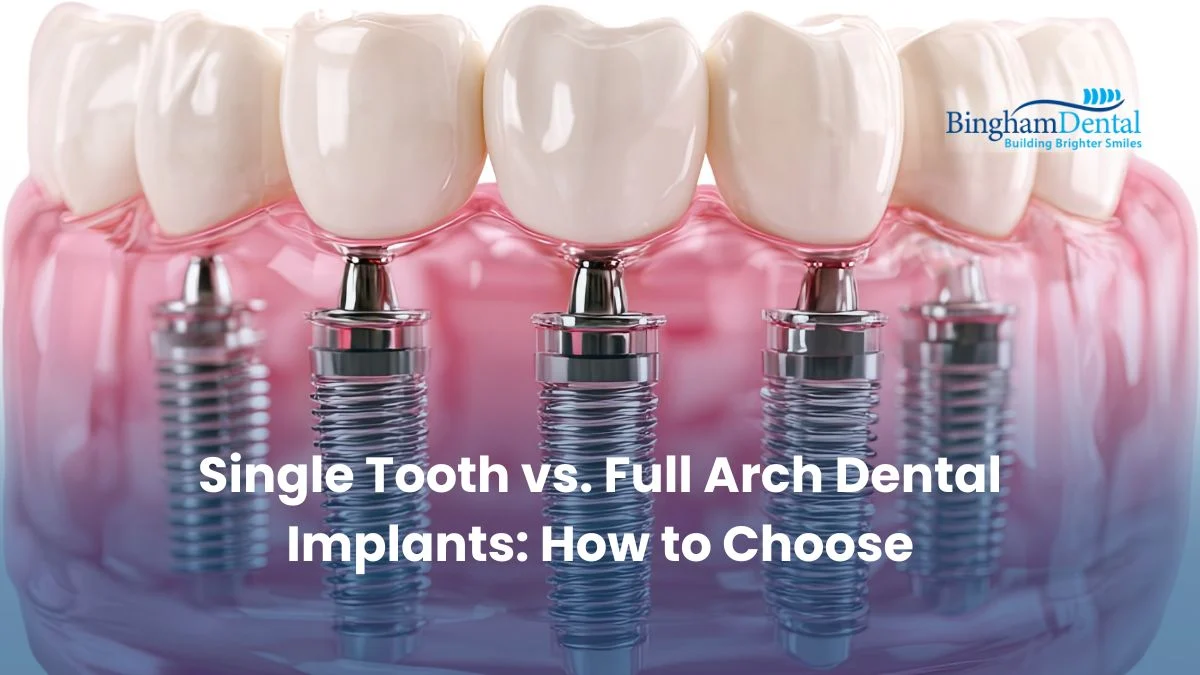
Missing teeth call for very different solutions depending on how many you’re replacing, which is exactly why single tooth vs full arch dental implants isn’t a one-size-fits-all decision. The right approach depends heavily on your specific situation.
Here’s how each option works, and how a dentist actually decides between them.
What a Single Tooth Implant Involves
A single tooth implant replaces one missing tooth with a titanium post surgically placed in the jawbone, topped with a custom crown once the area has healed. It’s the more conservative and less invasive of the two approaches, generally used when you’re missing just one tooth, or a few in different areas of the mouth, with otherwise healthy surrounding teeth.
Because each implant functions independently, a single tooth implant also leaves your other natural teeth completely untouched, unlike a traditional bridge, which requires reshaping the healthy teeth on either side of the gap to support it.
What Full Arch Implants Involve
Full arch implants replace an entire row of teeth — top, bottom, or both — using a small number of implants, often four to six per arch, to support a fixed, full bridge. This option is typically used when most or all of the teeth in an arch are missing, failing, or beyond saving, rather than trying to replace each tooth individually.
This approach, sometimes described using brand names like All-on-4, has become a common solution for patients who might otherwise be considering removable dentures, since it offers a fixed, non-removable alternative anchored securely to the jawbone.
How Dentists Decide Between Them
- Number of missing teeth: a single implant makes sense for one or two gaps, while full arch implants suit widespread tooth loss.
- Condition of remaining teeth: if most remaining teeth are compromised anyway, a full arch approach can be more efficient than saving them individually.
- Bone density and health: both options require adequate jawbone, though full arch treatment sometimes uses angled implants to work around lower bone volume.
- Budget and long-term goals: single implants can be done gradually, while full arch treatment is typically one larger, more comprehensive investment.
Recovery and Timeline Differences
A single tooth implant is less invasive, with a shorter surgical appointment and a more predictable recovery. Full arch treatment is a bigger procedure with more surgical sites at once, which generally means more initial swelling and downtime, even though many full arch systems now allow a temporary fixed bridge the same day as surgery. Both options still require three to six months of healing before the final restoration is placed.
Cost Differences
A single tooth implant costs less per tooth, but replacing many individual teeth one at a time can add up to more than a full arch solution designed to replace them all at once. Full arch implants have a higher upfront total cost but are often more cost-effective per tooth replaced when the number of missing teeth is high.
Weighing single tooth vs full arch dental implants on cost alone can be misleading without factoring in the number of teeth actually involved, so it’s worth asking your dentist for a real, itemized comparison based on your specific situation rather than a general price range.
What the Consultation Process Looks Like
Deciding between single tooth vs full arch dental implants starts with X-rays or a 3D scan to assess bone density and the condition of any remaining teeth. From there, your dentist can lay out a realistic timeline and cost estimate for each approach, so you’re choosing based on your actual mouth rather than a general comparison.
When Bone Grafting Comes Into the Picture
Some patients, especially those who have been missing teeth for a long time, don’t have quite enough bone density to support an implant right away. In these cases, a bone graft can rebuild the area over several months before the implant itself is placed, adding time to the overall process but generally not changing whether implants remain a realistic option.
Full arch approaches sometimes work around lower bone volume using angled implant placement instead of grafting, which is one more factor your dentist will weigh when comparing the two approaches for your specific case.
Life With Implants Afterward
Once healed, both single and full arch implants function much like natural teeth — no special cleaning products are required beyond regular brushing, flossing, and checkups. Unlike removable dentures, neither option needs to be taken out at night or held in place with adhesive, which is part of why so many patients describe implants as the closest thing to simply having their own teeth back.
Other Options If Implants Aren’t a Fit
Not everyone is a candidate for implants right away, whether due to bone density, certain health conditions, or personal preference. Traditional bridges and removable partial or full dentures remain reasonable alternatives, each with their own tradeoffs in cost, maintenance, and how closely they replicate the feel of natural teeth.
A dentist can walk through all of these options side by side during a consultation, so the final decision reflects your actual priorities rather than assuming implants are the only path forward.
Caring for Your Investment Long-Term
Both single and full arch implants can last decades, even a lifetime, with consistent care. Routine cleanings let your dentist check the health of the surrounding gum tissue and confirm the implant remains stable, catching any issues early rather than after they’ve become more serious. Skipping these checkups is one of the more common ways patients shorten the lifespan of an otherwise excellent long-term investment.
Getting Started With a Consultation
The first step toward either option is genuinely simple: a consultation with imaging, so your dentist can see exactly what you’re working with. Bring a general idea of your budget and timeline expectations, and you’ll leave with a realistic sense of which path — single implants, full arch treatment, or something else entirely — actually fits your situation.
The Bottom Line
The right choice comes down to how many teeth you’re replacing, the condition of what remains, and your own priorities around cost and timeline. There’s no universal answer, only the one that fits your particular mouth, which a proper consultation with imaging is really the only way to determine.
Frequently Asked Questions
Q: How painful is a single tooth implant?
Most patients describe single tooth implant surgery as far less painful than expected, since it’s performed under local anesthesia and typical post-surgical discomfort is manageable with over-the-counter pain relievers.
Mild swelling and soreness for a few days afterward is normal, but severe or worsening pain isn’t, and should be reported to your dentist promptly.
Q: What do people wish they knew before dental implants?
Patients most often say they wish they’d understood the full timeline better — implants typically take three to six months from placement to final restoration, not a single visit.
Many also mention wishing they’d asked more questions upfront about bone grafting needs, since a jaw with insufficient bone density may require an additional healing step before the implant itself can be placed.
Q: Why might a dentist prefer a bridge over an implant?
A dentist might recommend a bridge over an implant when a patient has insufficient bone density, health conditions that complicate surgery, or wants a faster, less invasive solution.
Bridges also don’t require a healing period the way implants do, which can matter for patients who need a functional, complete smile more quickly.
Q: What is the best type of dental implant to get?
There isn’t a single best implant type for everyone — the right choice between single tooth vs full arch dental implants depends on how many teeth you’re missing, your bone health, and your budget.
A consultation with X-rays or a 3D scan is the only reliable way to know which approach fits your specific mouth, rather than assuming one option is universally superior.
Conclusions
Choosing between single tooth vs full arch dental implants really depends on how many teeth you’re replacing and the condition of what remains. Single implants suit isolated gaps, while full arch treatment addresses widespread tooth loss more efficiently, and both require a real healing timeline, so patience matters either way. A consultation with imaging is the only way to know which path actually fits your mouth.
To find out which option makes sense for you, Bingham Dental in Magna offers a free consultation for implants and dentures.