
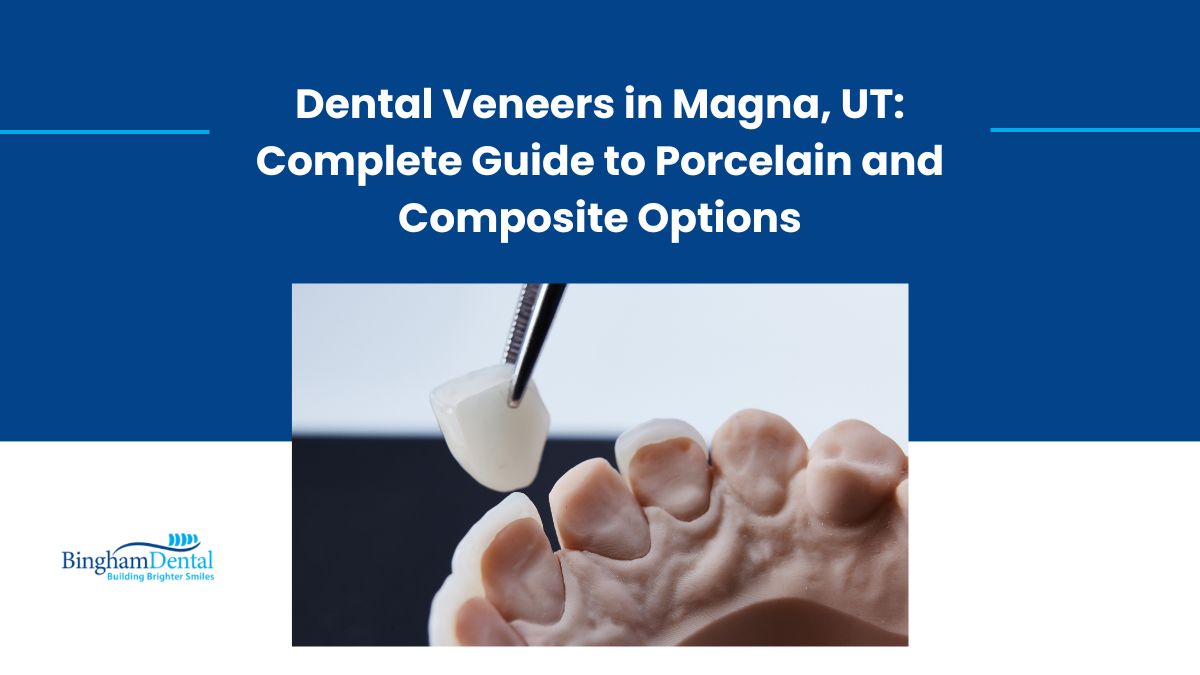
If whitening alone won’t get your smile where you want it — because of chips, gaps, uneven shapes, or stubborn discoloration — veneers are often the next step patients in Magna, UT consider. They’re one of the most versatile tools in cosmetic dentistry, capable of correcting multiple issues at once with results that look remarkably natural. Here’s what you need to know before your consultation.
What Are Dental Veneers?
Veneers are thin, custom-made shells, usually made from porcelain or composite resin, designed to cover the visible front surface of a tooth. Rather than replacing the tooth, a veneer bonds directly over it, masking imperfections while preserving as much of your natural tooth structure as possible.
They’re commonly used to address:
- Chipped or worn teeth
- Gaps or spacing irregularities
- Teeth that are discolored beyond what whitening can fix
- Teeth that are slightly misshapen or uneven in size
- Minor misalignment that doesn’t require full orthodontic treatment
Porcelain Veneers vs. Composite Veneers
This is usually the first big decision patients face, and both options have real advantages depending on your goals, timeline, and budget.
Porcelain Veneers
Porcelain veneers are fabricated by a dental lab from a custom impression of your teeth, then bonded into place during a follow-up visit. They’re prized for:
- Durability. With proper care, porcelain veneers commonly last 10–15 years or longer.
- Stain resistance. Porcelain resists staining far better than composite or even natural enamel.
- Natural translucency. Porcelain mimics the light-reflecting quality of real enamel, which is part of why well-made veneers are so hard to distinguish from natural teeth.
The tradeoff is time and cost — porcelain veneers typically require at least two appointments (one for preparation and impressions, one for placement) and tend to be a bigger upfront investment.
Composite Veneers
Composite veneers are built up directly on the tooth using a tooth-colored resin, sculpted and hardened in place, often in a single visit. Advantages include:
- Speed. Many composite veneers can be completed in one appointment.
- Lower cost compared to porcelain.
- Easier repair. If a composite veneer chips, it can often be touched up rather than replaced entirely.
The downside is that composite is more prone to staining over time and generally doesn’t last as long as porcelain — typically 4–8 years before needing replacement or refinishing.
What Happens During the Veneer Process?
While specifics vary by case, the general process looks like this:
- Consultation. Your dentist examines your teeth and gums, discusses your goals, and determines whether veneers are the right fit (healthy teeth and gums are typically required before cosmetic work begins).
- Planning and design. For porcelain veneers, an impression of your teeth is taken and sent to a dental lab, where your custom veneers are crafted. Shade, shape, and size are all planned around your facial features and remaining teeth.
- Tooth preparation. A small amount of enamel is typically removed from the front of the tooth so the veneer sits flush and looks proportional — this step is conservative, and the amount removed is generally minimal.
- Temporary veneers (porcelain only). While your permanent veneers are being fabricated, you may wear temporary veneers to protect your prepared teeth.
- Bonding. Once ready, veneers are bonded to the tooth surface using a strong dental cement, then polished and checked for fit and bite alignment.
Are Veneers Painful?
Most patients tolerate the process well. Tooth preparation is typically done with local anesthesia if any enamel needs to be removed, and any post-procedure sensitivity usually resolves within a few days. Composite veneers, since they don’t always require significant enamel removal, are sometimes even more comfortable in the short term.
How Long Do Veneers Last?
Longevity depends on the material and how well you care for them:
- Porcelain: 10–15+ years with good care
- Composite: 4–8 years, sometimes longer with regular polishing
Factors that shorten veneer lifespan include teeth grinding (bruxism), using teeth as tools (opening packages, biting nails), and poor oral hygiene that leads to decay at the margins of the veneer.
Caring for Your Veneers
Veneers don’t require dramatically different care from your natural teeth, but a few habits go a long way:
- Brush twice daily and floss regularly, just as you would for natural teeth.
- Avoid biting down on hard objects like ice, pens, or fingernails.
- If you grind your teeth at night, ask your dentist about a nightguard to protect your investment.
- Limit staining beverages like coffee, tea, and red wine, especially with composite veneers.
- Keep up with regular dental checkups so any issues are caught early.
Are Veneers Right for You?
Veneers are best suited for patients with reasonably healthy teeth and gums who want to correct cosmetic issues rather than significant structural or bite problems (which may call for other restorative or orthodontic treatment first). A consultation is the best way to find out whether veneers, or a combination of veneers with other treatments, will get you the result you’re after.
Frequently Asked Questions
Do veneers ruin your natural teeth? Veneer preparation typically involves removing a small, conservative amount of enamel so the veneer sits flush against the tooth. This step is not reversible, which is why the decision to move forward with porcelain veneers should follow a thorough consultation. Composite veneers, by contrast, often require little to no enamel removal.
Can veneers be whitened later? No — veneers, whether porcelain or composite, don’t respond to whitening treatments the way natural enamel does. This is why many patients choose to whiten their natural teeth to their desired shade first, then have veneers color-matched to that result.
What happens if a veneer chips or comes loose? Composite veneers can often be repaired or touched up relatively easily. Porcelain veneers, being a fabricated shell, typically need to be replaced rather than repaired if damaged. Either way, it’s worth having any damage evaluated promptly rather than waiting, since delaying can sometimes lead to further issues with the underlying tooth.
How many veneers do most people get? This varies widely based on individual goals. Some patients get a single veneer to address one damaged or discolored tooth, while others choose a full set across their most visible teeth (often six to ten) for a more uniform, complete smile transformation.
Are veneers reversible? Composite veneers, since they often involve minimal enamel removal, are closer to reversible than porcelain. Porcelain veneers, due to the enamel preparation involved, are generally considered a permanent commitment — another reason a thorough consultation and realistic expectations matter before moving forward.
Will veneers feel different from my natural teeth? Most patients report that veneers feel natural within a short adjustment period, since they’re custom-fitted to your bite and shaped to match your other teeth. Any initial awkwardness with speaking or biting typically resolves within a few days to a couple of weeks.
Considering Veneers in Magna, UT?
Whether you’re weighing porcelain against composite, or simply want to know if veneers are the right fit for your smile goals, the team at Bingham Dental can walk you through the options, show you examples in the Smile Gallery, and build a plan around your specific teeth and budget.
Bingham Dental 8370 West 3500 South, Magna, UT 84044 (801) 250-7422 Open Mondays 12:00 PM – 7:00 PM; Tuesday through Thursday 7:00 AM – 5:00 PM
Schedule your veneer consultation today and take the first step toward a smile you’re proud to show off.